 Storywork
The learning opportunity
The emotional value of a gift may be different from its price or appearance. Attend to the giver’s intention and the receiver’s response. Invite appreciation that does not require children to disclose family circumstances or compare material possessions.
Learning goal
Students reflect on the meaning behind gifts, the importance of thoughtfulness, and how compassion can be expressed in many forms.
Competencies: Empathy, Social Awareness, Relationship Skills, Gratitude
Sharla’s story
Gifts are something that teachers of young children receive lots of. From gift cards and school supplies to a handful of dandelions picked on the way to school—each one special and treasured in its own way. At Christmastime, the gifts come more frequently, and while I would always say, “All I need is a big squishy hug,” my students and their families still spoiled me with their generosity.
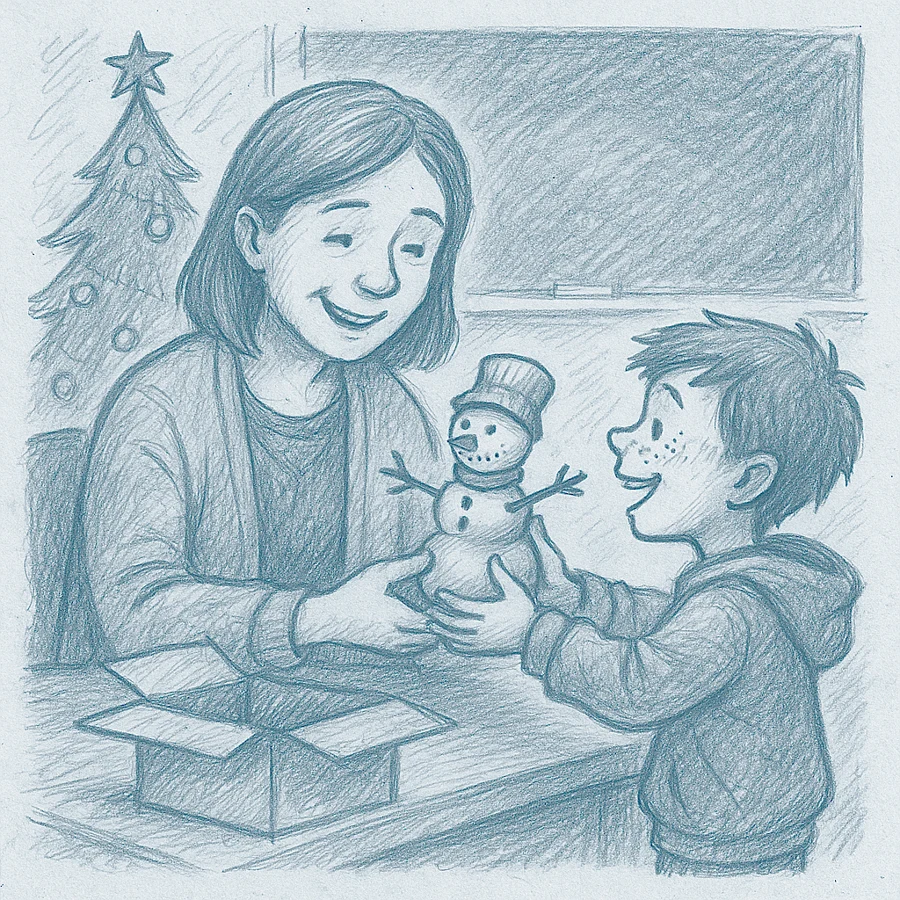
One year, a student named Jacob arrived early and asked to see me before the day began. I had a busy morning ahead, but he was holding something and wore a smile that I could never ignore. Jacob had a crooked tooth grin and a freckled face framed by auburn hair. His sweatshirt was old and stained, and his jeans too short, but he radiated joy.
“Mrs. Steever, I made this for you!” he said, thrusting a shoebox wrapped in stained newspaper into my lap. Duct tape held the box together, and he quickly explained, “We didn’t have wrapping paper or that clear tape.” I reassured him that I loved newspaper wrapping and that duct tape certainly worked.
Inside the box, I carefully moved aside crumpled newspaper and found a handmade snowman. Not just any snowman—this one was made from one of Jacob’s own worn-out socks. It was gray and stained, filled with toilet paper, tied in the middle to make a head and body, with twig arms and a hand-drawn face. It had a faint smell that made it clear it came straight from his foot.
Jacob beamed. “Do you like it, Mrs. Steever?! I made it all by myself. My mom said we didn’t have enough money to buy teacher presents this year, but I really wanted to give you something. I love you!”
He gave me the biggest hug, and I fought back tears. “I love this snowman,” I told him. “It means so much that you made it yourself. I’ll keep it right here by my desk to remember you.”
He grinned wide again, said, “OK, I gotta go play!” and ran off. I sat quietly, letting my tears fall, holding that sweet, stinky snowman. It still sits on my shelf today.
Jacob gave me more than a snowman—he gave me a deeper understanding of compassion and the value in simple, heartfelt gifts. Sometimes our kids come from hard circumstances, but the capacity to care can still shine through in the most powerful ways.
Step 2: Lesson Plan – "Empathy and the Meaning of Giving"
Objective: Students reflect on the meaning behind gifts, the importance of thoughtfulness, and how compassion can be expressed in many forms.
Part 1: Discussing the Story (10–15 mins)
Why did Jacob make a gift even without money?
What made this gift so special to Mrs. Steever?
Can gifts have value even if they cost nothing?
Part 2: Gifts from the Heart (15–20 mins)
Write about or draw a time you gave or received a meaningful gift.
Reflect on what made it matter so much.
Part 3: Kindness Tree (20 mins)
Create a classroom tree with leaves that represent kind, generous actions.
Add to it throughout the week as students give or notice acts of kindness.
Spark, shutdown and reflection
Journal Prompts:
A Spark: When did someone give you something truly meaningful?
A Shutdown: When did you want to give but didn’t think it was good enough?
How can simple gestures have lasting impact?
Sharing Options:
Gift gallery: drawings of gifts that mean something to students
Share kindness notes anonymously with classmates
Ask students: "What makes a gift truly valuable? How can we make someone feel seen and appreciated without spending anything?"
Companion guidance by Scott Simpson and Sharla Steever. Consult the book alongside these resources; activities and summaries do not replace the complete book.