 Storywork
The learning opportunity
The desire to understand a distant life can also guide an encounter with a neighbor or classmate. Ask questions that invite a story rather than confirm an assumption. Preserve the teller’s choice and give listening the same attention as speaking.
Learning goal
Students will explore their own curiosity about the past and apply it to learning about the people around them today.
Competencies: Social Awareness, Relationship Skills, Self-Awareness, Responsible Decision-Making
Scott’s story
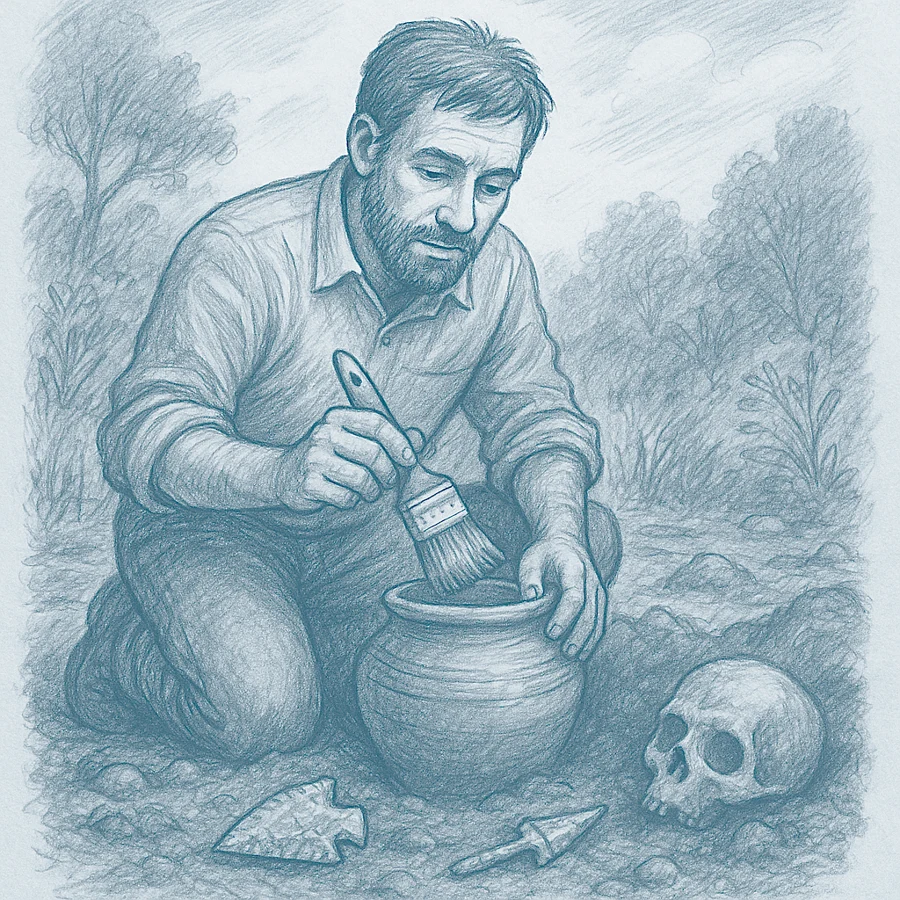
I always kind of wanted to be an archaeologist—someone who digs and finds old things used by people a long, long, long time ago. Pottery, arrowheads, baskets, cloth, bits of metal—evidence of lives and civilizations, whether just decades old or ancient.
As a kid, I loved digging in the dirt looking for clues from the past. I remember once finding the china foot of an old doll from the 1800s. It was broken, but I spent hours just holding it, imagining the little girl or adult who owned it. Was it a plaything? Was it a display? What stories did it once belong to?
There's a trail near my house now, and along it, half-buried in the dirt, is an old tire—likely from the 1910s. A Model T car, maybe. How did it get there? Who drove through these woods a hundred years ago?
Further along is a stone fireplace, all that remains of an old cabin. Scattered around it are rusted cans—beans, meat, food from a century past. I imagine a family relying on those supplies, surviving a long winter with what they had.
Discovering things like that sparks something in me. These objects tell stories. They reveal people—people like us, but different too. And they make me want to know more. That’s what archaeologists do: ask questions about the past. Who lived here? What did they believe? What did they build, trade, and eat?
But the more I thought about it, the more I realized: there are just as many stories around us right now. Stories that aren’t buried. Stories walking around in people we pass every day. Stories waiting to be heard.
What if we brought the same curiosity to those around us today?
What if we said: "Hi, here’s my story. I’d like to hear yours"?
We live in the same world, in the same moment. If I can hear how someone else understands this life, I can understand my own life better too.
Stories are everywhere. And if we listen with an open mind and an open heart, we can grow and connect in powerful ways.
Step 2: Lesson Plan – "Discovering Living Stories"
Objective: Students will explore their own curiosity about the past and apply it to learning about the people around them today.
Part 1: Discussing the Story (10–15 mins)
Why was Scott drawn to archaeology?
What did old objects teach him?
How can that same curiosity help us connect with people in our lives now?
Part 2: From Artifacts to People (15–20 mins)
Each student brings in a small object or draws one that matters to them.
Share the story behind it with a partner or group.
Part 3: Story Swap Interviews (20 mins)
Pair students to ask each other three story-starting questions:
What’s something from your past that shaped who you are?
Who is someone that influenced you?
What’s a place that means a lot to you?
Each student then introduces their partner to the class through a short story.
Spark, shutdown and reflection
Journal Prompts:
A Spark: When did you feel excited to learn about someone else’s life or culture?
A Shutdown: When did you miss a chance to listen or connect?
How does being curious help us understand people better?
Sharing Options:
Wall of Curiosity: Post questions students want to ask others
Circle of Stories: Each week, one student shares an object and story with the class
Ask students: "If every person is a story waiting to be uncovered, what would it mean to become story-archaeologists? What can we find in one another if we really look and listen?"
Companion guidance by Scott Simpson and Sharla Steever. Consult the book alongside these resources; activities and summaries do not replace the complete book.