 Storywork
The learning opportunity
Fear is not identical for every learner. Explore what support helps someone take a manageable next step and how they can ask for it. Avoid turning courage into pressure to confront something before they are ready.
Learning goal
Students reflect on times they’ve faced something scary or difficult and what gave them courage to move forward.
Competencies: Self-Awareness, Self-Management, Social Awareness, Responsible Decision-Making
Scott’s story
When I was in first grade, I was a really happy kid—at least when I was at home. My parents worked at a college, and we lived in a dorm on campus in our own apartment. The campus was my playground. I knew every sidewalk, every tree. I climbed them, explored them, and felt completely at home in every season: fall leaves, winter snow, spring wildflowers, and the quiet of summer when the students were gone. That whole campus felt safe. Nothing could hurt me there.
But school was a different story. My first-grade teacher was not very kind. I don’t think she meant to be mean, but she was young, struggling, and didn’t seem to know how to manage a classroom in a gentle way. She would lose her temper and say or do things that scared me. So school felt unsafe.
One morning, I really didn’t want to go. My mom urged me to get ready. “You’re not sick, Scott. Let’s go. You don’t want to miss learning.”
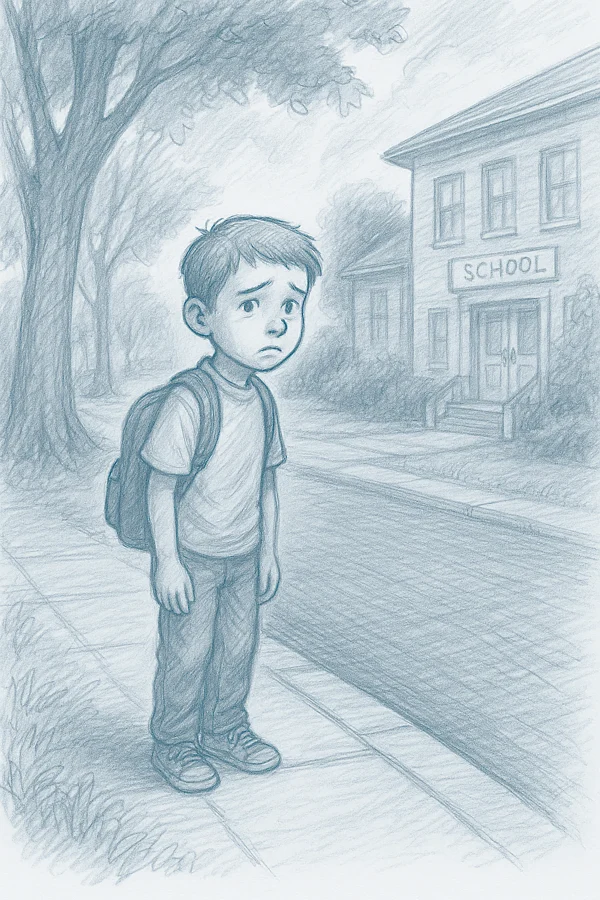
So I left, walking the few blocks across the campus slowly, dragging my feet, stopping to look at every flower, every stick, every tree—anything to delay the moment I had to cross over into that darker space.
I reached the edge of campus. I stood at the curb. Across the street was the school. That curb felt like a line between two worlds: one safe and warm, the other cold and scary.
I stood there for what must have been ten minutes. Then the school bell rang. I knew I was late. I knew they’d be calling my mom. I knew people would start worrying.
I felt stuck. I didn’t want to go, but I also didn’t want to let everyone down.
So I stepped off the curb.
I walked to school.
That day was hard. But I made it. And the next day, I did it again. Some days were worse than others, but some were better. I made it through that year. And the next one. And the next.
I started to learn that I could face hard days. I could get through them. I had people who cared. I could say, “This is hard,” and they’d listen and help.
And I learned that good days come, too. And they feel even better when you know you have what it takes to walk through the hard ones first.
Step 2: Lesson Plan – "Crossing the Curb"
Objective: Students reflect on times they’ve faced something scary or difficult and what gave them courage to move forward.
Part 1: Discussing the Story (10–15 mins)
What did the curb represent for Scott?
Why was school so hard for him that year?
What helped him keep going?
Part 2: My Line, My Courage (15–20 mins)
Students draw a scene of a time they had to cross their own “curb.”
Underneath, write about what helped them step forward.
Part 3: Courage Toolbox (20 mins)
Create a class list of tools and people we can turn to when facing something hard.
Decorate courage cards to keep in a desk or notebook as reminders.
Spark, shutdown and reflection
Journal Prompts:
A Spark: When did someone help you get through a hard day?
A Shutdown: When did something feel too scary or lonely?
What do you want to remember next time things feel tough?
Sharing Options:
Safe story sharing circles
Courage wall: anonymous notes of encouragement for others in tough moments
Ask students: "What is your version of the curb? What helps you take the next step when it’s hard? Who can you talk to when things feel scary?"
Companion guidance by Scott Simpson and Sharla Steever. Consult the book alongside these resources; activities and summaries do not replace the complete book.