 Storywork
The learning opportunity
Feedback becomes more useful when it identifies what happened and a possible change. Invite learners to separate an outcome from identity and recognize the work worth carrying forward. A fictional attempt can provide a low-pressure route into discussing disappointment.
Learning goal
Students will explore how to handle disappointment and learn from feedback, recognizing that mistakes are part of the growth process.
Competencies: Self-Awareness, Growth Mindset, Resilience, Reflection
Sharla’s story
When I was younger, I participated in 4-H, and one of the things we did was prepare exhibits to enter in our county fair. I worked hard each year to make projects that I could be proud of—and I always hoped to earn purple ribbons, the top award.
One year, I made a batch of gingersnaps for the fair. I was so proud of them—they were crispy on the outside, tender on the inside, and I had carefully selected three that looked almost identical to enter. I dropped them off to be judged and looked forward to seeing how they would do.
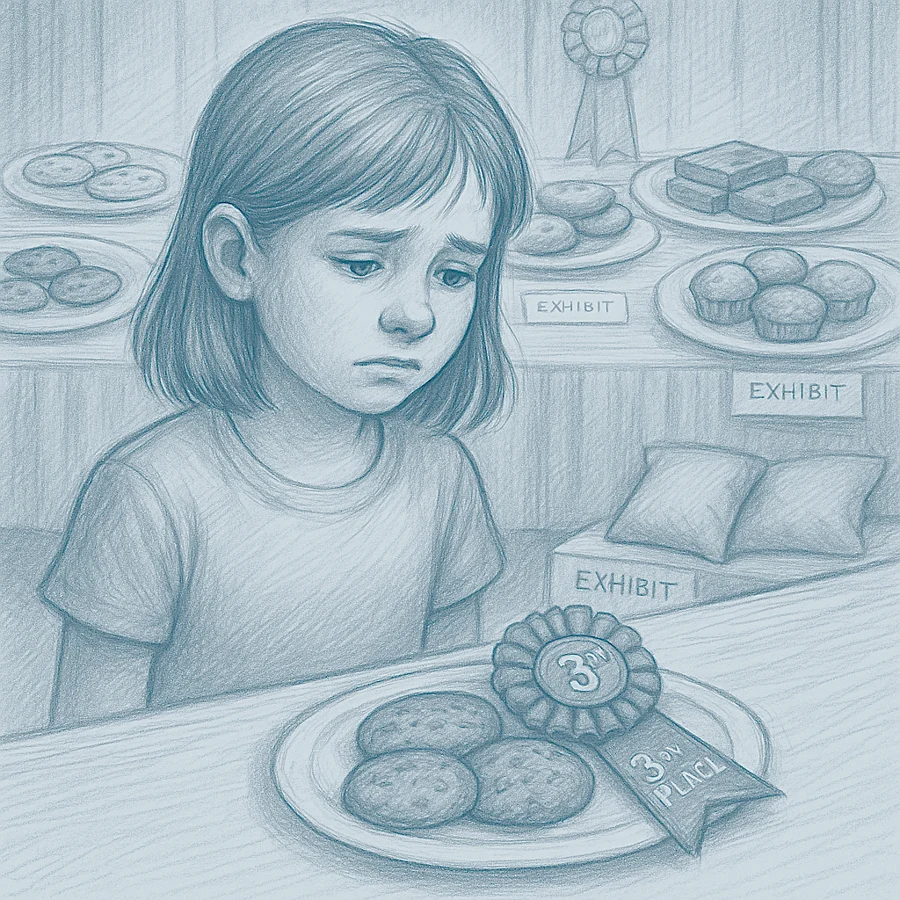
Later that day, I returned to the fairgrounds to check the results. I was sure I had a good chance at a purple ribbon. But when I got there, I saw that my cookies hadn’t received a purple. They hadn’t even gotten a blue. They had received a red ribbon—third place.
I felt crushed. I was disappointed in myself and unsure what had gone wrong. That evening, we were heading to my brother’s baseball team potluck, and my mom suggested we take the rest of the gingersnaps along. I told her I wasn’t sure they were good enough, but she encouraged me.
At the potluck, I set the cookies out on the table. A woman nearby saw them and smiled, saying, “Oh, gingersnaps—my favorite!” I responded shyly, “I don’t know if you’ll like these. They only got a red at the fair today.”
She took a bite and then looked at me kindly. “I remember judging these,” she said. “You know what happened? The one you submitted had a pocket of baking soda in it—an unmixed spot. That’s why I had to give it a red. But this one? It’s delicious. I would’ve given it a purple.”
That moment stuck with me. I still felt disappointed about the ribbon, but I also learned something important: sometimes, small mistakes can affect outcomes, but they don’t define your whole effort. And I learned to be a better baker, too—mix thoroughly!
Step 2: Lesson Plan Theme
Theme: Disappointment, Growth, and Perspective Goal: Students will explore how to handle disappointment and learn from feedback, recognizing that mistakes are part of the growth process.
Classroom Discussion Prompts:
What happened when Sharla’s cookies were judged at the fair?
How did she feel at first?
What did she learn from the judge’s comment at the potluck?
How can disappointment help us grow?
Spark, shutdown and reflection
Spark Story Prompt:
Write or talk about a time you felt disappointed in something you worked hard on. What did you learn from that experience?
Describe a time when someone gave you kind or helpful feedback. How did that make you feel?
Shutdown Reflection Prompt:
Tell about a time when your best effort didn’t feel good enough to others. How did you respond?
Reflection Options:
Draw your own “award-winning” project and write what you’re proud of.
Write a recipe for success that includes ingredients like perseverance, feedback, and learning from mistakes.
How can you remember your whole effort, even when others only see one small part?
Companion guidance by Scott Simpson and Sharla Steever. Consult the book alongside these resources; activities and summaries do not replace the complete book.