 Storywork
The learning opportunity
Stress can narrow the interpretation of a group’s behavior. The unit invites a pause to recognize humanity and rebuild connection. Discuss humor that relieves pressure without making someone the target, and connect the insight with practical ways to repair trust.
Learning goal
Students will explore how stress and vulnerability affect relationships, and reflect on how humor and humanity can transform group dynamics.
Competencies: Self-Awareness, Social Awareness, Relationship Skills, Responsible Decision-Making
Scott’s story
When I first started teaching high school, I was barely older than the seniors in my classes. That made me nervous. I worried they wouldn’t respect me, and that insecurity showed—especially in how I handled classroom control.
There were times when students wouldn’t listen, talk over me, or flat-out ignore instructions. I didn’t yet know how to stay calm and steady. Often I’d let things slide for too long, trying not to cause a scene. But the pressure would build up inside me until I exploded—yelling, sending someone to the office, or losing my temper.
That wasn’t the kind of teacher I wanted to be. But I didn’t know another way yet.
One afternoon in my theater class near the end of the school day, things were getting out of hand. I’d been trying all period to get everyone focused. Twenty-plus students were chatting, laughing, ignoring me completely. I was exhausted and worn thin.
Finally, I stood in the middle of the room and yelled, “You all sound like a bunch of animals!”
Silence.
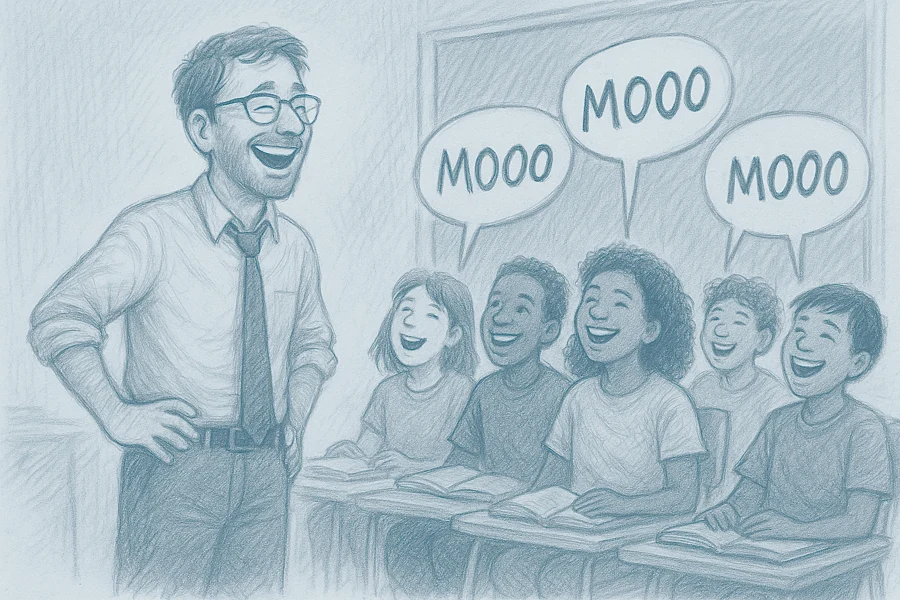
And then, from the back corner: “Moo.”
Then another, louder: “Moo!”
And then another. Until the entire class was mooing like a herd of cows.
I froze. And then—I laughed. I couldn’t help it. The absurdity, the release, the shared moment—it all came crashing through. I laughed, and then they laughed. We laughed together for a solid five minutes.
No, we didn’t get much done that day. But something shifted in that moment. The tension broke. The fear eased. We saw each other not as teacher versus students, but as human beings trying to make it through a tough moment.
The rest of the week, the class still had its challenges. But we had a different energy. There was more trust. I knew they weren’t trying to destroy me. And they knew I wasn’t out to control them—I was just trying to help them learn.
And sometimes, all it takes to start building a better relationship is a little bit of laughter—and a well-timed moo.
Step 2: Lesson Plan – "Teaching, Tension, and Trust"
Objective: Students will explore how stress and vulnerability affect relationships, and reflect on how humor and humanity can transform group dynamics.
Part 1: Discussing the Story (10–15 mins)
Why did the teacher feel insecure?
What caused the explosion—and what changed after the mooing?
How did laughter help build trust?
Part 2: Pressure Points (15–20 mins)
Reflective writing: When have you felt pressure to stay in control? What happens when you hit your limit?
Share in pairs: What helped you reconnect or calm down?
Part 3: Humor and Healing (20 mins)
Create skits or comics based on moments when laughter helped repair tension.
Optional: Write "permission slips" for being human—mistakes, emotions, all included.
Spark, shutdown and reflection
Journal Prompts:
A Spark: When did laughter help shift a hard moment into something better?
A Shutdown: When did stress or fear cause you to shut down or lash out?
How can we create more space for humor, grace, and trust in tough moments?
Sharing Options:
Storytelling circle
Illustrated journals
"Moo Moments" bulletin board: funny classroom stories that helped build connection
Ask students: "What helps us turn tension into trust? How can we be more human with each other—especially when things go wrong?"
Companion guidance by Scott Simpson and Sharla Steever. Consult the book alongside these resources; activities and summaries do not replace the complete book.