 Storywork
The learning opportunity
The unit explores the cost of hiding an unfinished skill and the connection made possible by appropriate honesty. Learners can name a skill they are practicing rather than reveal an embarrassing event. Support a next step and recognize capability beyond one difficulty.
Learning goal
Students will explore the value of honesty about our challenges and celebrate the uniqueness of our personal strengths.
Competencies: Self-Awareness, Self-Management, Relationship Skills, Social Awareness
Scott’s story
When I first became a teacher, I was hired at a large high school to teach English and coach drama. I was excited—and anxious. I felt like an imposter. I had gone to college and studied hard, but I still felt like there were things I didn’t know or wasn’t very good at, especially compared to the experienced English teachers around me.
One of the things I always tried to hide was that I wasn’t great at spelling. That had embarrassed me since I was young. In fact, I think it was why my handwriting had gotten so messy—I figured if no one could read it clearly, maybe they wouldn’t know I had misspelled something.
Then came my first big mistake.
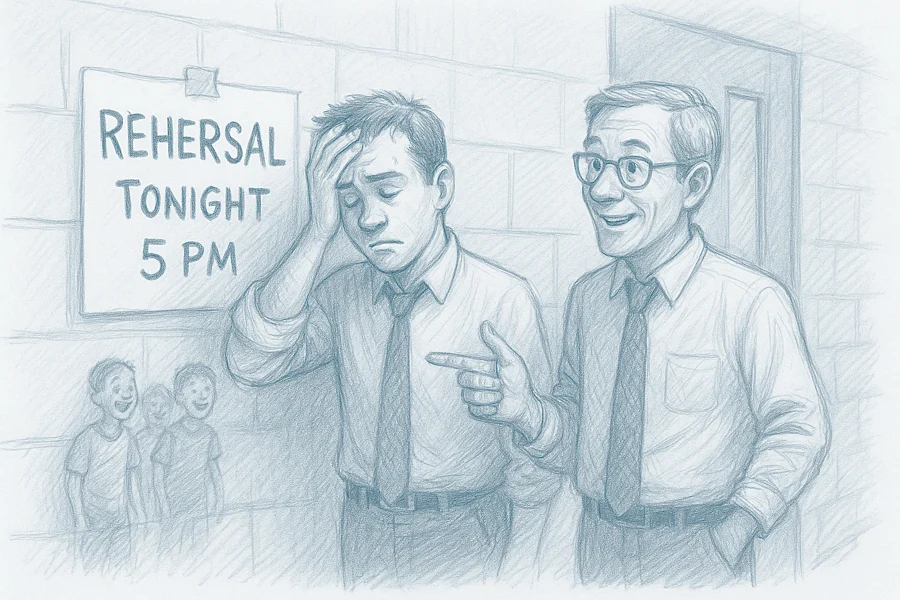
I was preparing for our first drama rehearsal. I made a poster with bold magic marker: “Rehersal Tonight at 5.” I hung it proudly outside my door.
Then Mr. Taylor, one of the other English teachers, stopped by. He was kind and didn’t tease me or point it out publicly. But quietly, he said, “Hey Scott, I noticed your sign. Did you spell ‘rehearsal’ that way on purpose?”
I blinked. “Oh no, did I spell it wrong?”
“Yeah,” he said, gently. “You might want to change it. Just remember: it has the word ‘hear’ in it.”
I thanked him and fixed the poster, but inside, I felt ashamed. I thought, how can I be a real English teacher if I can't spell a word like rehearsal?
Over time, I learned that the other teachers had things they struggled with too. Some of them were even things I was good at.
Now, as a more experienced teacher, I understand something important: everyone has strengths, and everyone has areas where they need help. Hiding your struggles might protect your pride, but it also keeps people from knowing the real you. It keeps you from growing.
I still struggle with spelling sometimes. But I’ve written poems, plays, songs, and even books. I want the people I trust to know the real Scott—both the talents and the trouble spots. Because that’s how we really connect.
Step 2: Lesson Plan – "Strengths and Struggles"
Objective: Students will explore the value of honesty about our challenges and celebrate the uniqueness of our personal strengths.
Part 1: Discussing the Story (10–15 mins)
Why did Scott feel like an imposter?
How did Mr. Taylor respond to Scott’s mistake?
What helped Scott start to feel more confident?
Part 2: Two Sides of Me (15–20 mins)
Students fold a paper in half: one side for “Things I’m Good At,” one for “Things I’m Working On.”
Share with a partner (if comfortable) and reflect: How do our challenges shape us?
Part 3: Authentic Identity Portraits (20 mins)
Students create a visual portrait using symbols or words that show their strengths and struggles.
Gallery walk to celebrate everyone’s honesty and growth.
Spark, shutdown and reflection
Journal Prompts:
A Spark: When did someone support you in an area you felt insecure?
A Shutdown: When did you try to hide something about yourself? Why?
How does it feel when you’re seen and accepted as your full self?
Sharing Options:
Story circles with talking pieces
Wall of Realness: anonymous sticky notes with personal truths and affirmations
Ask students: "What happens when we let others see our whole selves—not just the good stuff? How can we build a community that honors both strength and struggle?"
Companion guidance by Scott Simpson and Sharla Steever. Consult the book alongside these resources; activities and summaries do not replace the complete book.