 Storywork
The learning opportunity
The unit invites empathy for changes in a loved one and attention to what remains meaningful. Learners can reflect on a caring moment without sharing a loss. Offer an ordinary memory or fictional character as another route into the conversation.
Learning goal
Students will reflect on the impact of memory and aging on relationships, and explore how love and empathy can remain strong even when memories fade.
Competencies: Social Awareness, Relationship Skills, Self-Awareness, Responsible Decision-Making
Scott’s story
When I was a kid, we used to drive down to Arkansas to visit my grandparents. My Grandma and Grandpa Simpson lived in El Dorado, tucked away among tall pine trees in the humid, green southern part of the state. My grandpa had a huge garden, and their lawn was full of tiny frogs—you could pull back any patch of grass and find one. It felt magical.
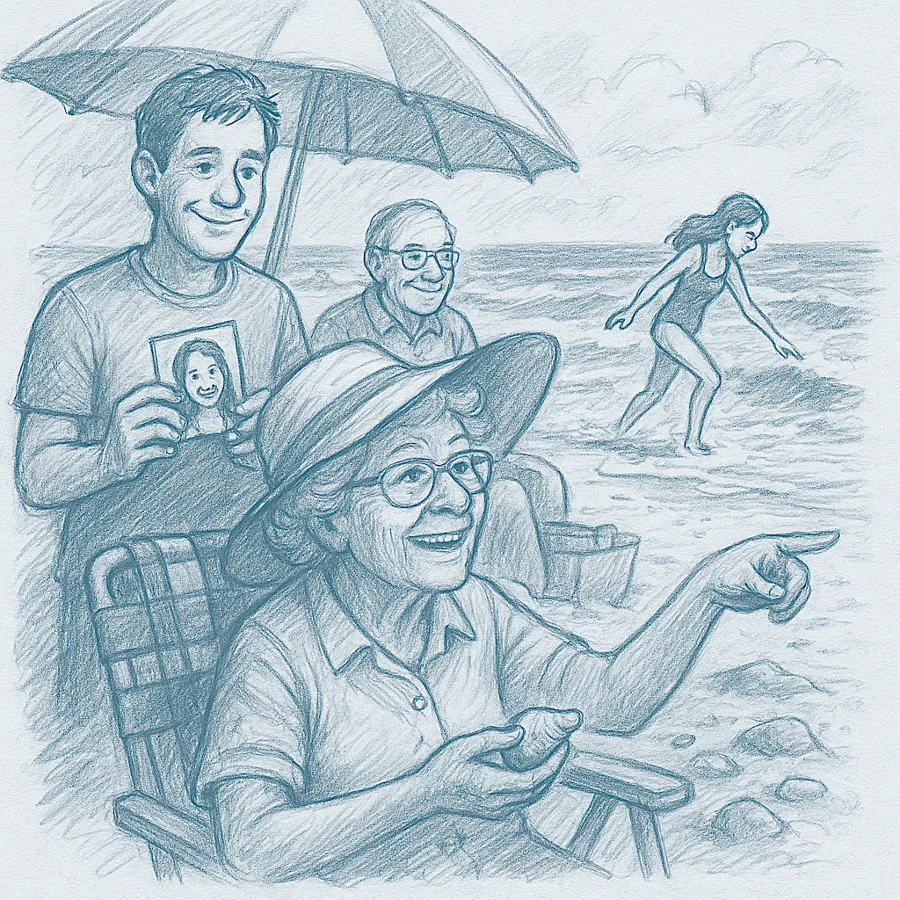
We often took trips with them to Pensacola, Florida, camping in their pop-up camper and playing in the waves on white sandy beaches. My grandma loved collecting seashells. By the end of every trip, she had a whole treasure trove to bring home.
The last trip we took was when I was a freshman in college. My grandma had been diagnosed with Alzheimer’s—a disease that slowly takes away memory and clarity. It was heartbreaking, but she still remembered me then. She was still her sweet, warm self, speaking in her gentle southern accent, pinching my cheek and asking about my girlfriend at college.
“Hey Scott, do you have a picture of that girlfriend?” she’d ask.
I always had one in my wallet, and I showed her. “Mmm, she is so pretty. Beautiful, beautiful teeth,” she’d say. Then, with concern: “Now she’s a Christian, right?” I’d say yes, and we’d move on.
She would read road signs aloud as we drove: “Sunshine State… Gas and Food… Grocery Store…” She couldn’t help it, and even though it was repetitive, we all were patient. We knew it was part of what was happening to her.
Later, she’d ask again, “Scott, do you have that picture?” And I would show her, every time like it was the first. Every time, she’d smile and comment again: “She’s got such pretty white teeth. Now she’s a Christian, right?”
At the beach, she gave us lessons on shell hunting: “Catch it with your toes, hold it down with your foot, then bend down real quick before the wave washes it away!”
That trip was special. It was the last time she really remembered me. After that, the disease took more from her. But I’ll never forget who she was, or those sweet, funny moments. I’m so thankful she got to see that picture of my girlfriend—who is now my wife—before her memory faded.
Step 2: Lesson Plan – "Memory, Change, and Love That Lasts"
Objective: Students will reflect on the impact of memory and aging on relationships, and explore how love and empathy can remain strong even when memories fade.
Part 1: Discussing the Story (10–15 mins)
What do you notice about the way Scott treats his grandma?
Why do you think he keeps showing her the picture again and again?
What does this story say about love and patience?
Part 2: Understanding Change (15–20 mins)
Brainstorm: What changes as people grow older?
Discuss: How can we show kindness and understanding when someone we love is changing?
Part 3: Story Reflections (20 mins)
Students write or draw a memory with a grandparent or elder.
Optional prompt: “What would you want to say to them if they started to forget who you were?”
Spark, shutdown and reflection
Journal Prompts:
A Spark: When did you feel especially close to a grandparent or elder?
A Memory: What is a moment you hope to remember forever?
A Lesson: What did someone older teach you that still matters today?
Sharing Options:
Memory map drawing
Class tribute wall with shared memories
Letters to a grandparent or elder
Ask students: "What makes a memory stick? How can we honor people we love even when they begin to forget?"
Companion guidance by Scott Simpson and Sharla Steever. Consult the book alongside these resources; activities and summaries do not replace the complete book.