 Storywork
The learning opportunity
The unit asks learners to consider their part in a chain of events, including giving something to another person. Accountability can include consequences, honesty, and repair. Discuss the choices in the story and how someone could seek help or act differently next time.
Learning goal
Students will explore the themes of responsibility, peer pressure, and accountability, and reflect on the importance of owning up to one’s actions.
Competencies: Self-Awareness, Responsible Decision-Making, Social Awareness, Self-Management
Scott’s story
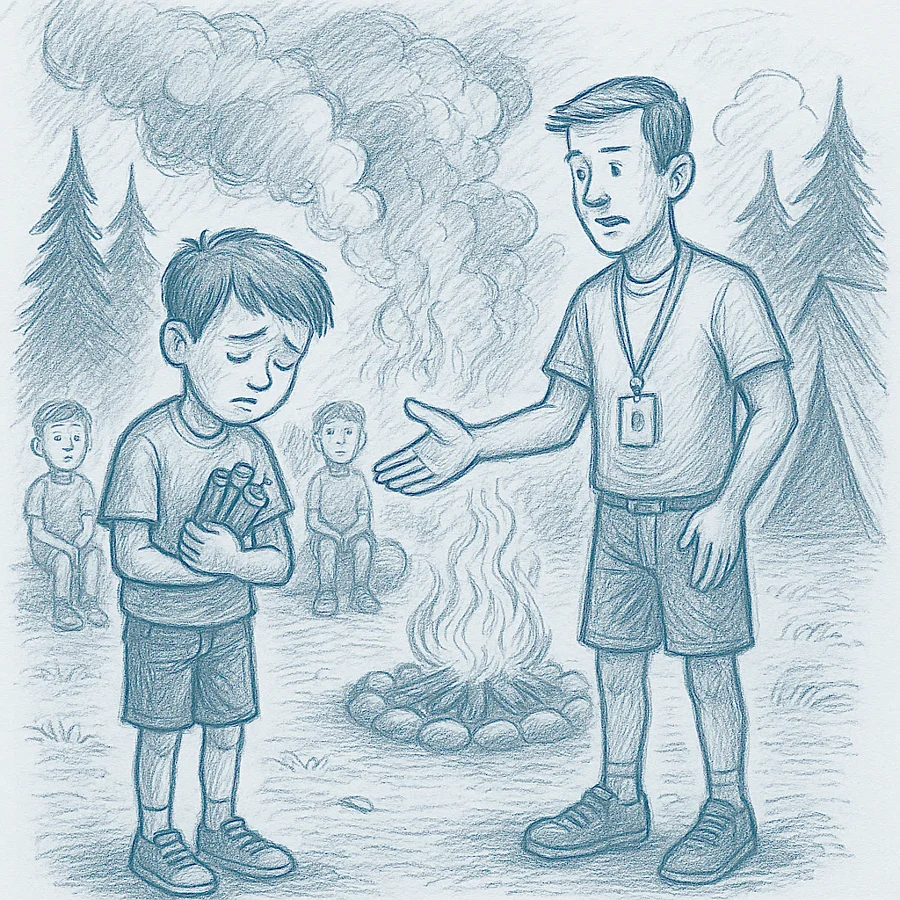
I used to love going to camp in the summer. From the time I was eight through the end of eighth grade, I went every year to a small camp in Nebraska. It was a place full of cottonwood trees, a lake for swimming, and a river that flowed alongside it. One year, I arrived just after the Fourth of July, and I still had fireworks on my mind.
Camp had one very clear rule: no fireworks, no matches, no lighters. No fire—except what adults supervised. Nebraska could be dry, and a single spark could start a serious fire.
But I was excited about the leftover firecrackers I had. So, against the rules, I packed a string of them in my suitcase without my parents noticing. The first night, I snuck outside and lit one or two just to see if anyone would hear. They popped. Then I got scared. I didn’t want to get caught. I decided to throw them away.
That's when Joey, another camper, found out. He said, "Don't throw them away—give them to me. You won’t get in trouble if I have them." So I handed them over and tried to forget about it.
Later that day, smoke filled the air. A grass fire had started west of camp and was heading our way fast. We all rushed out with wet towels to beat the flames. We worked all afternoon trying to contain the fire before it reached the buildings. Eventually, we succeeded.
That evening, the director gathered us. "The fire was started by fireworks," he said. "We know who lit them. But we also know he didn't bring them to camp. We want that person to come forward."
My parents were there that evening, sitting right beside me. They had no idea I had broken the rule. But I knew I had to tell the truth. I stood up, walked to the front, and admitted I had brought the fireworks.
The director said, "Thank you, Scott. What you did was wrong. Even if you gave them to someone else, you broke a serious rule." He explained I might need to miss out on some activities and do extra work to make amends.
My parents were heartbroken. They considered taking me home. But they agreed with the director’s plan. They let me stay—with a promise that I would follow the rules from then on.
It was a hard moment. But it taught me about responsibility, honesty, and facing consequences.
Step 2: Lesson Plan – "Responsibility and Making Things Right"
Objective: Students will explore the themes of responsibility, peer pressure, and accountability, and reflect on the importance of owning up to one’s actions.
Part 1: Discussing the Story (10–15 mins)
What choices did Scott make that contributed to the fire?
How did it feel when he decided to come forward?
What was the role of Joey in this story? Was Scott still responsible?
Part 2: Accountability in Action (15–20 mins)
Brainstorm: When is it hardest to tell the truth?
Discuss: What can make it easier to admit when we’ve done something wrong?
Part 3: Role Play or Journaling (20 mins)
Students act out or write alternate endings: What if Scott hadn’t confessed? What if Joey had refused to take the fireworks?
Reflect: What do these choices teach us about integrity?
Spark, shutdown and reflection
Journal Prompts:
A Spark: When did you do the right thing, even though it was hard? How did it feel?
A Shutdown: When did a mistake lead to a harsh consequence? What would you do differently now?
What did you learn about yourself from that moment?
Sharing Options:
Story circle with group reflection
Anonymous submissions shared by the teacher
Visual representations: timelines, storyboards, or symbolic drawings
Ask students: "Why is it sometimes hardest to do the right thing when it matters most? What kind of support helps us make good choices?"
Companion guidance by Scott Simpson and Sharla Steever. Consult the book alongside these resources; activities and summaries do not replace the complete book.